
Revitalizing Language
Revitalizing Language, Culture, and Commerce:
The Role of Hawaiian Language in Business and Climate Resilience

As Hawaiʻi continues to reclaim and celebrate its Indigenous identity, the Hawaiian language ʻŌlelo Hawaiʻi is reemerging not only in homes and schools but also in a powerful new space: the business sector.
The use of Hawaiian in business is more than a cultural nod; it is an act of renormalization, restoring the language to its rightful place in everyday life. For Native Hawaiian-led businesses and those serving Hawaiʻi communities, incorporating ʻŌlelo Hawaiʻi is a strategic, values-based, and economically beneficial move. The ʻĀinapreneur Small Business Hawaiian Language Program by Changemakers Community Economic Development Corporation is at the forefront of this movement.
WHY LANGUAGE IN BUSINESS MATTERS
The Hawaiian language once thrived in commerce, schools, and governance. But following the illegal overthrow of the Hawaiian Kingdom and decades of suppression, its use declined dramatically. Today, revitalization efforts have made huge strides with immersion schools, university programs, and online tools fueling a growing base of speakers.
Still, for ʻŌlelo Hawaiʻi to thrive, it must go beyond classrooms. It must live in the places where people gather, work, and spend. That includes businesses from small agritech startups to mom and pop stores.
Larger companies like Hawaiian Airlines have seen success incorporating Hawaiian into employee training and customer engagement, helping passengers feel at home from Boston to Japan. However, small businesses, which make up the backbone of Hawaiʻi’s economy, often lack the resources to do the same.
HAWAIIAN LANGUAGE BUILDS BRAND IDENTITY AND CUSTOMER LOYALTY
In a saturated marketplace, language is not just a means of communication. It is a differentiator.
When businesses use ʻŌlelo Hawaiʻi in greetings, signage, websites, customer service, or product packaging, they are not just adding local flavor. They are communicating values of respect, authenticity, and rootedness. This is especially meaningful in Hawaiʻi, where customers make purchasing decisions based not only on price and quality but also on how well a business reflects shared cultural values.
A 2021 University of Hawaiʻi study found that 76 percent of U.S. visitors were willing to pay more for experiences offered by Native Hawaiians, with language and culture playing a key role in their perception of authenticity. Similarly, local customers often choose airlines, banks, and stores that reflect Hawaiian values and use the language as a signal of trust and familiarity.
Small businesses participating in ʻĀinapreneur report growing customer appreciation for the use of Hawaiian, often leading to deeper relationships and return business. The language evokes a feeling of home, of ʻohana, of belonging. These are not just cultural benefits; they are brand advantages.
ʻĀinapreneur formalizes this process by helping businesses develop language-based customer experiences and branding touchpoints, from employee scripts to signage to Hawaiian language certificates. All of these reinforce a business’s commitment to community and culture—and that commitment builds loyalty.
HAWAIIAN LANGUAGE AS A TOOL FOR CLIMATE RESILIENCE
Language is not just communication; it is a knowledge system. ʻŌlelo Hawaiʻi encodes centuries of environmental observation, resource management practices, and regenerative values essential for surviving and thriving in Hawaiʻi’s unique ecosystems.
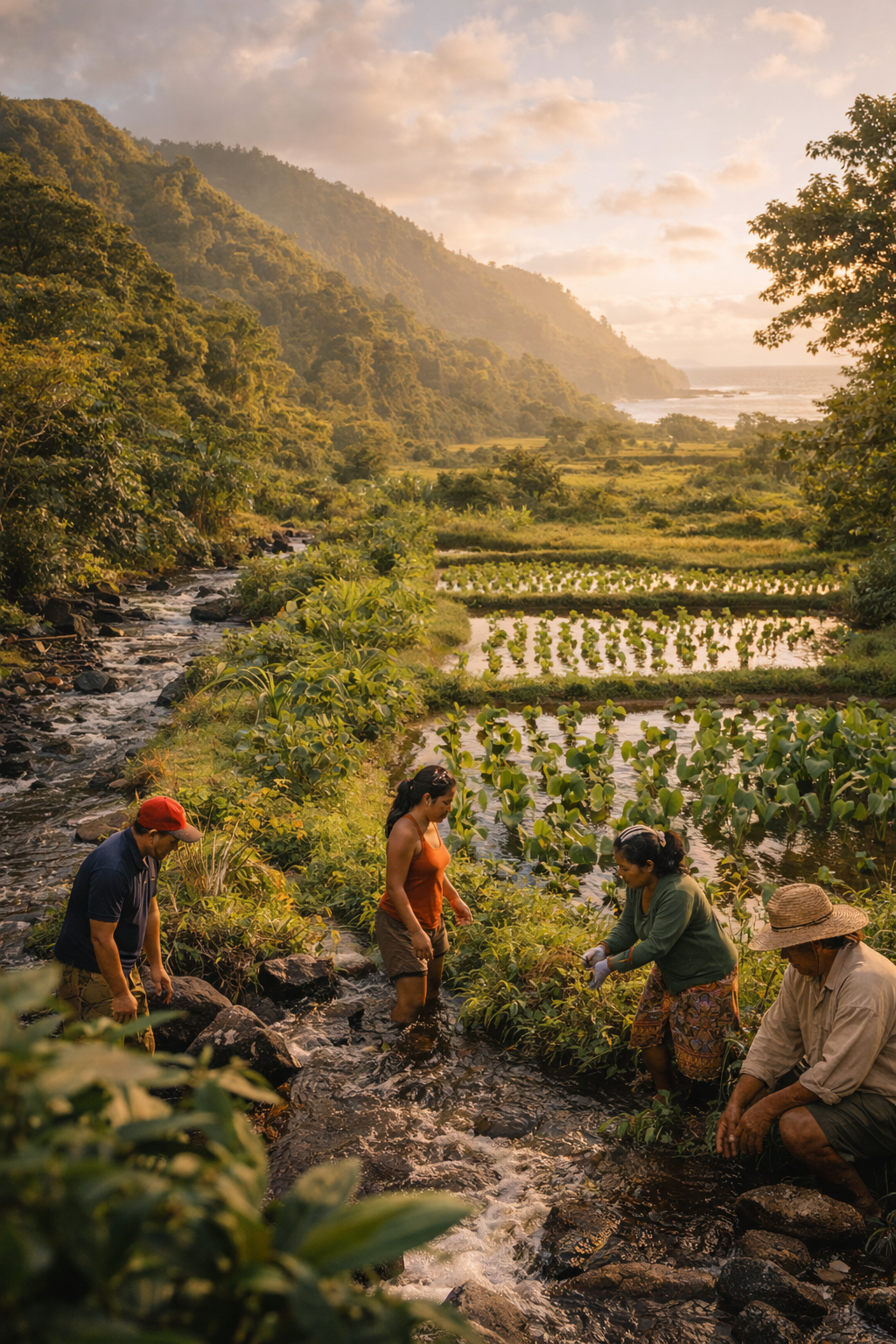
Terms like ahupuaʻa, mālama ʻāina, wao akua, and laulima are not easily translated. They represent entire systems of thinking that guide water management, land stewardship, communal labor, and reciprocal relationships with the environment. When small businesses use Hawaiian language, they are not just signaling culture; they are activating traditional ecological knowledge.
This connection becomes especially powerful in the face of climate change.
Businesses that integrate Hawaiian language and values are more likely to adopt low or non-extractive models that prioritize sustainability, circular economies, and place-based decision-making. Whether it is a tech startup using Hawaiian frameworks to track seasonal changes or a farm cooperative adopting ancestral water practices, language becomes a roadmap for resilience.
By embedding ʻŌlelo Hawaiʻi into business models, entrepreneurs are reclaiming Indigenous data systems and applying them to contemporary challenges.
This is why the ʻĀinapreneur program is also aligned with the broader climate resilience movement in Hawaiʻi. Through the ʻĀinaprise Workforce Development Collective, Changemakers is uniting agriculture, technology, and education sectors around a shared vision: a regenerative economy rooted in language, land, and legacy.

A CERTIFICATION FOR LANGUAGE AND LEGACY
To recognize commitment, participating businesses can earn the ʻĀinapreneur Certification. This mark of cultural stewardship reflects a business's integration of ʻŌlelo Hawaiʻi, support for local sourcing, regenerative practices, and respect for Hawaiian values. It is not only a badge of honor but also a market differentiator and a signal of climate leadership.
LANGUAGE AS A CLIMATE AND ECONOMIC SOLUTION
In a world seeking just and local climate solutions, Indigenous languages are not a relic of the past; they are blueprints for the future.
Hawaiian language revitalization is business revitalization. It is climate resilience. It is brand loyalty. It is an investment in a thriving, interdependent Hawaiʻi.
Through programs like ʻĀinapreneur, small businesses are not just learning words. They are restoring worldviews, reactivating traditional knowledge, and building the foundations for a regenerative economy that speaks Hawaiian.