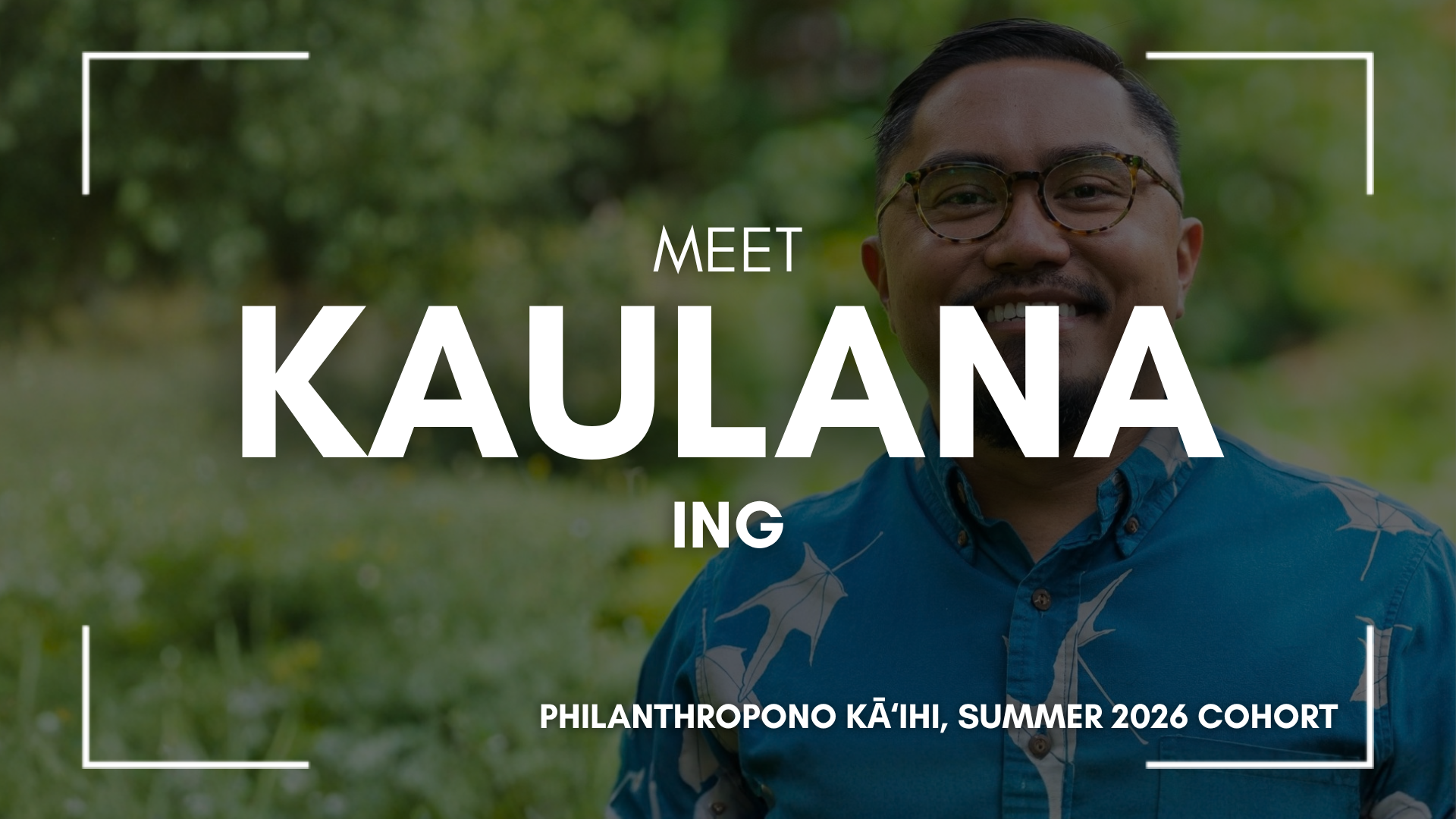

Beyond the Horizon: Kaulana Ing’s Philanthropono Journey
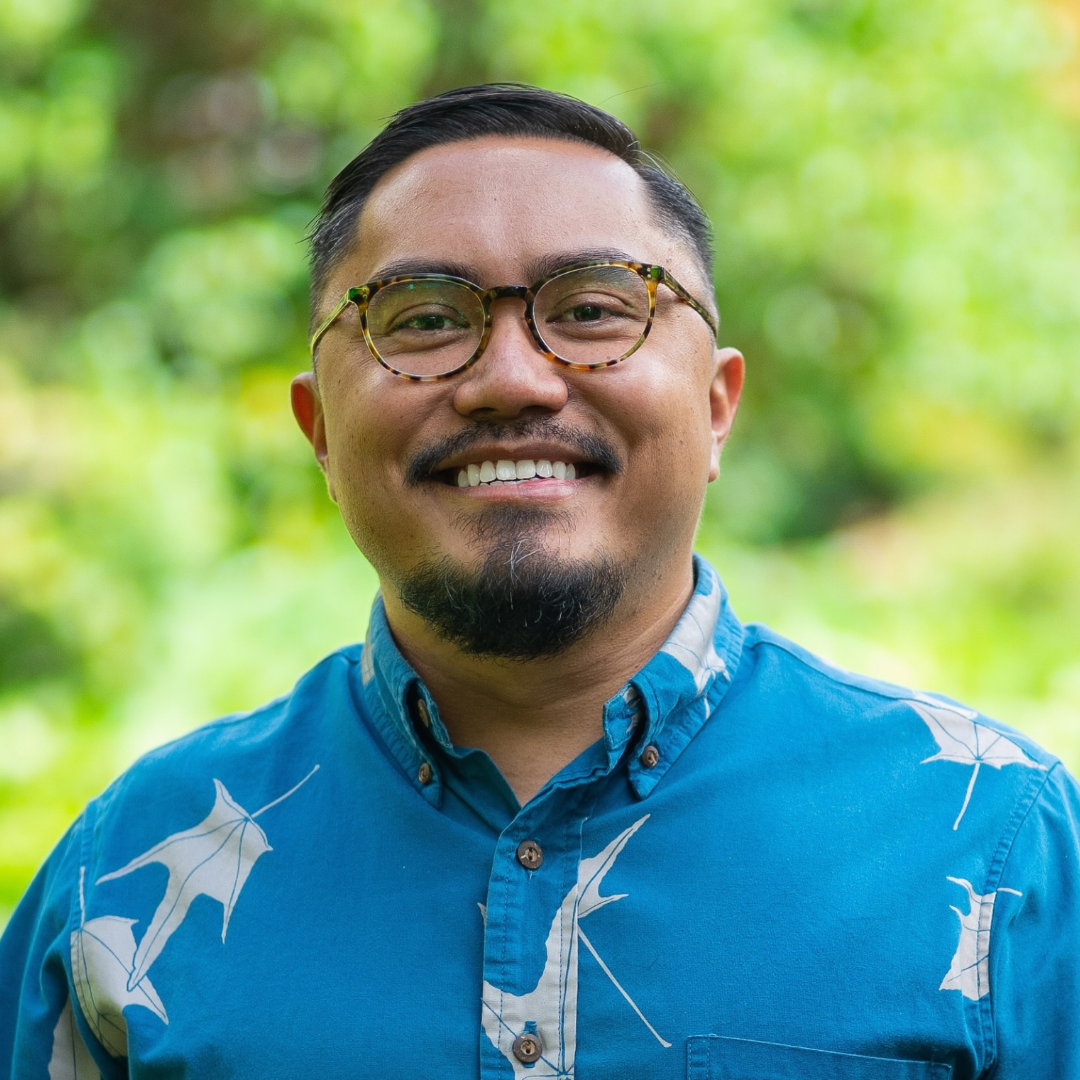
When Kaulana Ing introduced himself at the Summer 2026 Hōʻike, his title only told part of the story.
“I am the COO, occasional janitor, and whatever else needs being done at Kula ʻo Kūlaniākea Hawaiian Immersion School,” he shared with a smile.
It was a lighthearted introduction to work carrying a much deeper purpose.
As a member of Philanthropono’s Kāʻihi intermediate cohort, Kaulana represented Kūlaniākea, a Hawaiian language and nature immersion school in Kāneʻohe whose mission is simple and expansive: Advancing Indigenous Education. Kūlaniākea centers Hawaiian language, culture, and values while giving keiki regular opportunities to learn beyond classroom walls—in outdoor learning environments, through ʻāina, and aboard waʻa. Its vision is to nurture courageous and caring kiaʻi, grounded in their values and their unique purpose to serve the lāhui.
Kaulana began his Hōʻike by inviting everyone into that world.
Through a virtual visit to the kula, families described keiki learning outdoors, sailing on the wake of kūpuna, developing fluency in ʻōlelo Hawaiʻi, and building foundations that can steady them throughout their lives.
One parent captured that sense of grounding beautifully:
“Language doesn’t leave you, ʻāina doesn’t leave you…those are the things that even in the darkest of times…are still around you.”
For Kaulana, scenes like these are extraordinary precisely because, to the children themselves, they are ordinary.
At Kūlaniākea, keiki play together in ʻōlelo Hawaiʻi. They invent games and imaginary worlds through their language. They learn with educational materials created specifically for them, grounded in Hawaiian worldview and ʻike kūpuna. They spend time on the ocean and in the mountains—not as an occasional field trip, but as part of school.
“It’s not a performative protocol,” Kaulana explained of the way the keiki engage with culture and language. “It’s something that they feel in their hearts.”
The ability to offer that experience did not appear overnight.
Kaulana was intentional about acknowledging the generations who made it possible.
He spoke of kūpuna who developed systems of knowing, living, and relating to place over countless generations, and of the people of the Hawaiian Renaissance who fought for ʻōlelo Hawaiʻi to survive and again become a language through which children could be educated.
“We definitely owe our privilege to the work of the people who came before us,” he said.
That history also helps explain why Kūlaniākea is approaching the future differently.
A previous generation necessarily focused on language revitalization and survival—creating opportunities for as many families as possible to once again learn and live through ʻōlelo Hawaiʻi.
That work succeeded in profound ways.
Today, Kaulana shared, at least 75 percent of Kūlaniākea families have a Hawaiian language speaker in the parent generation—a generational marker that allows the school to build from a different starting point.
Rather than expanding broadly into multiple locations, Kūlaniākea is choosing to go narrow and deep.
Its focus is on one place, continually strengthening its pedagogy, developing Hawaiian-language educational materials, expanding nature-based learning, and pursuing excellence across subject areas.
Kūlaniākea’s own educational philosophy reflects that approach. Its materials describe education as a partnership among keiki, ʻohana, school, and community, with culture-based learning and aloha ʻāina helping children build identity, curiosity, independence, and a love of learning.
For Kaulana, the ʻāina itself is central to that education.
“ʻĀina is the best kumu,” he shared, “the best teacher.”
Keiki learn about food systems, water, ecosystems, navigation, and relationships with place. Once a month, they sail aboard double-hulled waʻa, learning something even larger than navigation: how to imagine what exists beyond what they can currently see.
They learn, Kaulana explained, “to envision what’s beyond the horizon and to set their goals to something that they can’t yet see.”
That idea—looking beyond the horizon—also shaped Kaulana’s Philanthropono work.
As Kūlaniākea approaches its tenth year in 2027, his focus has been preparing the organization to capture the momentum, relationships, and possibilities that milestone can create.
That begins with what Kaulana calls an ʻupena waiwai—a net of resources and relationships.
Some of the work is foundational: building an email system, beginning a regular newsletter, strengthening donor management, and making it easier for community members to give, particularly through recurring gifts.
But the larger goal is not simply better fundraising infrastructure.
Kaulana wants Kūlaniākea to deepen its relationship with community by giving generously as well—sharing coloring books, language lessons, educational resources, and other ways families can bring ʻike Hawaiʻi into their homes.
“We really want to be offering more than we’re asking for,” he said.
That approach is also part of a larger vision of financial sovereignty.
Kūlaniākea has successfully secured federal support, and Kaulana made clear that the organization will continue pursuing those opportunities. But he also sees the risks of depending too heavily on any single funding source.
“In order for us to practice our approach with integrity,” he explained, “we need to have sovereignty in our financing—self-determination of where our funding comes from.”
For Kūlaniākea, that means growing unrestricted support from within its own community while developing additional ways to generate revenue and extend its impact.
One opportunity is the educational materials already being created by its kumu. Through the Nō Nā Hanauna initiative, Kūlaniākea hopes to work more closely with cultural practitioners to develop books, puzzles, language resources, worksheets, and other materials rooted in ʻike Hawaiʻi—creating resources for families and schools while also helping practitioners sustain their own work.
Another opportunity is the school’s waʻa program. With a canoe that can travel directly to schools, Kūlaniākea can bring culturally grounded learning experiences to students who may not otherwise have access to the ocean because of transportation, cost, or liability barriers.
And then there is something even bigger.
Kaulana believes the Kūlaniākea pedagogy itself has something meaningful to contribute to education.
Teachers, schools, and organizations are already seeking professional development from Kūlaniākea. Kaulana envisions a future in which its Indigenous educational approach is discussed alongside internationally recognized teaching methodologies—not as an addition to someone else’s educational framework, but as an evidence-based practice with value in its own right.
Meeting that demand, however, requires capacity.
Kūlaniākea’s most experienced kumu cannot simply leave their classrooms to train others without affecting the quality of education its own students receive. Kaulana’s vision therefore includes developing an internal pipeline that recruits, retains, and prepares the next generation of kumu—allowing master teachers eventually to share their knowledge more broadly without sacrificing what happens inside the kula.
And nowhere is the need for growth more visible than Kūlaniākea’s waitlist.
At the time of Kaulana’s Hōʻike, more than 110 families were waiting for an opportunity to enroll their keiki.
The barrier is not interest.
It is space.
Kūlaniākea is currently limited by the physical capacity of its campus. Looking beyond its tenth anniversary, the organization hopes to move toward a new campus that reflects its educational philosophy—not a large institutional building, but smaller structures integrated with ʻāina in the spirit of a kauhale, ideally surrounded by loʻi kalo, traditional foods, water, and other places with which keiki can develop relationships.
A larger campus could open the door for more children.
But in Kaulana’s telling, the real vision reaches much farther than enrollment numbers.
During the conversation following his presentation, he began imagining the keiki seen in the Kūlaniākea video decades from now.
“Seeing these little keiki on the screen and then imagining what kind of kūpuna, what kind of elders they’ll be—that’s a strong vision.”
That may be the clearest expression of Kaulana’s Philanthropono journey.
The work is not simply about funding a school.
It is about supporting a generational continuum.
One generation fought to keep ʻōlelo Hawaiʻi alive.
Another built schools and language nests so children could once again learn through Hawaiian.
Today, Kūlaniākea has the opportunity to build upon that foundation—to deepen Indigenous pedagogy, strengthen kumu, expand access, create greater financial self-determination, and prepare children to navigate challenges that cannot yet be fully seen.
Much like the keiki aboard Kūlaniākea’s waʻa, the organization is learning to look toward what lies beyond the horizon.
And the goal is not simply to prepare children to survive whatever they find there.
It is to give them such a strong relationship with language, ʻāina, culture, and community that they can paddle confidently toward it—and one day become the kūpuna who help guide the generations following behind them.
Ready to strengthen your fundraising practice?
The next Philanthropono cohort is an opportunity to build practical fundraising skills while staying rooted in Indigenous values, relationship, and community care.
Read more and watch other participants and the entire Summer 2026 Kaʻiʻi & Kāʻihi Hōʻike presentation.